Showing posts with label sexual violence. Show all posts

Wednesday, June 30, 2010

Fighting Rape in the Congo

The Daily Beast currently has several features on rape in Congo.  A blog post by Dana Goldstein checks in on a $17 million US government program.

The State Department has provided The Daily Beast with documents detailing how the $17 million to fight sexual violence have been allocated, mostly toward treatment programs for rape survivors. But human rights advocates hope for more. They believe the US should stop sending hundreds of millions of dollars in aid--including military training--to Rwanda and Uganda, whose armed militias perpetrate violence and rape across the border in Congo. They also criticize the administration and Congress for failing to crack down on multinational corporations that operate mines in the country, some of which have paid off armed groups in exchange for access to mineral deposits.

And advocates contend the U.S. should take a leadership role in reforming the United Nations mission in Congo, MONUC, which is regarded as ineffectual at best, corrupt and complicit at worst. The U.S. contributes about a quarter of the funding for the mission—about $337.5 million annually—but no troops. MONUC’s mixed record has led Congolese President Joseph Kabila to pressure the UN to pull its peacekeepers out of Congo by the end of 2011.
She points to the mining trade as a root of the violence and notes that bipartisan legislation that requires electronics companies to disclose whether manufacturing materials are sourced from the Congo does not go far enough.

But critics say the international community, led by the United States, needs to police the mining industry more heavily, and ensure that a significant percentage of Congo's mining profits benefit the nation's citizens. "Electronics companies are seven steps down the supply chain,” said Carney of Friends of the Congo. “Focus on the mining companies. Impunity exists not only in Congo but all the way up the chain to the international level.”
Other highlights of the feature include a profile of Chouchou Namegabe, an anti-rape activist, and a photo essay of survivors of sexual violence.

Friday, June 12, 2009

"Enfants Mauvais Souvenirs"


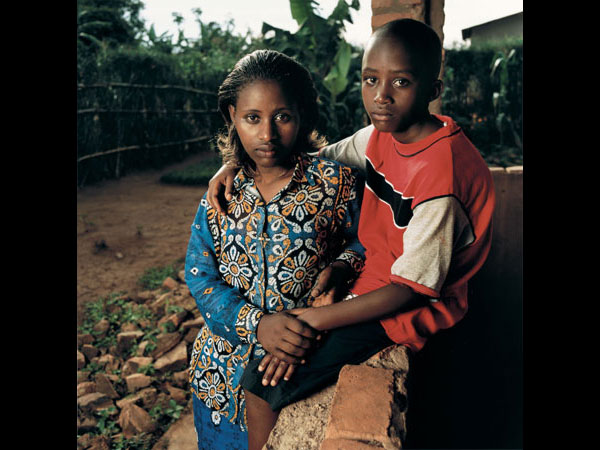
Slate has an article and slideshow on images by photojournalist Jonathan Torgovnik's of children born of rape during the Rwandan genocide. An estimated 20,000 children were born to Tutsi women who were systematically raped and forced into sexual servitude by members of Hutu militia groups. Torgovnik's images and the testimonies he collected are published in his book "Intended Consequences: Rwandan Children Born of Rape."

The testimonies do not make for easy reading. More than half of the women Torgovnik interviewed are HIV-positive. Most live in dire poverty, ostracized by their own families and communities because of the stigmas attached to rape and AIDS. In Rwanda, a heavily patriarchal society, children of wartime rape are perceived as belonging to the enemy. As Josette, the mother of Thomas, recalls, "My uncle didn't welcome me into his house. He asked me who was responsible for my pregnancy. I said if I am pregnant, then it must be the militias since many of them had raped me. He said I shouldn't enter his house carrying a baby of the Hutus and chased me away. I left, but I didn't know where to go. Later, my uncle told me that I could only enter his house if I agreed to throw away the child."

The women discuss their own feelings about their children with heartbreaking candor. Some confess their inability to feel love or affection for children who are living reminders of the terrible ordeals they endured. Others say that their children are their only source of hope and consolation, that without them they wouldn't have the will to survive. Their stories are stark dramas of evil and innocence, brought to life with horrific specificity.

(Image: "Odette with her son, Martin," Intended Consequences: Rwandan Children Born of Rape, photographs and interviews by Jonathan Torgovnik (Aperture, 2008). From the Slate alideshow.)

Sunday, June 7, 2009

Helping Victims of the "Virgin Myth"

This week's CNN Hero is Betty Makoni, a native of Zimbabwe who founded the Girl Child Network (GCN). Many young girls in Zimbabwe are the victims of
a widely held belief that if a man with HIV or AIDS rapes a virgin he will be cured of his disease. This so-called virgin myth, perpetuated by Zimbabwe's traditional healers, has led to the rape of hundreds of girls, according to UNICEF. Some of those victims are too young to walk, much less protect themselves.
Makoni's organization help these girls through 700 girls' clubs and three "empowerment villages" where girls who have been abused receive emergency medication, reinstatement in school and counseling.

Makoni's efforts are feature in "Tapestries of Hope" a feature length documentary on the virgin myth and its victims.

Monday, June 1, 2009

Darfur Rape Epidemic

A study by Physicians for Human Rights (PHR) details the threat of rape faced by Darfuri women, both at home and at refugee camps.

PHR's report, titled "Nowhere To Turn: Failure To Protect, Support and Assure Justice for Darfuri Women," tells the stories of 88 women refugees living at the Farchana camp in Chad, a country that borders the Darfur region of Sudan.

Some 17 of the 88 women -- who were interviewed by four female researchers, including three physicians -- reported instances of "confirmed or highly probable rape" occurring in their Darfur villages during attacks. They and many other women fled and sought safety in neighboring Chad, but did not escape the danger. Another 15 of the 88 women reported being raped in the refugee camp, said PHR.

PHR's press release is available here.

Thursday, May 28, 2009

Do the Detainee Abuse Photos Show Rape?

According to Ret. Major General Antonio Taguba, the author of the Abu Ghraib report, the photos that the Obama Administration decided not to release "show rape." (Foreign Policy's Passport blog has some background.)

Allegations of rape and abuse were included in his 2004 report but the fact there were photographs was never revealed. He has now confirmed their existence in an interview with the Daily Telegraph.

The graphic nature of some of the images may explain the US President’s attempts to block the release of an estimated 2,000 photographs from prisons in Iraq and Afghanistan despite an earlier promise to allow them to be published.

Maj Gen Taguba, who retired in January 2007, said he supported the President’s decision, adding: “These pictures show torture, abuse, rape and every indecency.

“I am not sure what purpose their release would serve other than a legal one and the consequence would be to imperil our troops, the only protectors of our foreign policy, when we most need them, and British troops who are trying to build security in Afghanistan.

“The mere description of these pictures is horrendous enough, take my word for it.”

Blogger Larisa Alexandrovna notes that pictures like these have already been released. On UN Dispatch, Mark Leon Goldberg thinks the victims' right to privacy should be taken into account as well.

Wednesday, May 27, 2009

"Even after peace arrives, rape persists"

On a visit to Liberia, Nicholas Kristof investigates child rape in Liberia and measures being taken to prevent it and to prosecute the perpetrators.

Of course, children are raped everywhere, but what is happening in Liberia is different. The war seems to have shattered norms and trained some men to think that when they want sex, they need simply to overpower a girl. Or at school, girls sometimes find that to get good grades, they must have sex with their teachers.

“Rape is a scar that the war left behind,” said Dixon Jlateh, an officer in the national police unit dealing with sexual violence. “Sexual violence is a direct product of the war.”