Thursday, June 10, 2010
ICTY Convicts 2 of Genocide
Friday, October 2, 2009
International Criminal Court to Address Post-Election Violence in Kenya
Sunday, August 23, 2009
The Right Way to Help
The photo, of a Sudanese toddler on her way to a food distribution center, was taken by South African freelance photographer Kevin Carter. In 1993, Carter made a trip to document the famine in Sudan:
Immediately after their plane touched down in the village of Ayod, Carter began snapping photos of famine victims. Seeking relief from the sight of masses of people starving to death, he wandered into the open bush. He heard a soft, high-pitched whimpering and saw a tiny girl trying to make her way to the feeding center. As he crouched to photograph her, a vulture landed in view. Careful not to disturb the bird, he positioned himself for the best possible image. He would later say he waited about 20 minutes, hoping the vulture would spread its wings. It did not, and after he took his photographs, he chased the bird away and watched as the little girl resumed her struggle. Afterward he sat under a tree, lit a cigarette, talked to God and cried. "He was depressed afterward," Silva recalls. "He kept saying he wanted to hug his daughter."However, some critics questioned his ethics:After another day in Sudan, Carter returned to Johannesburg. Coincidentally, the New York Times, which was looking for pictures of Sudan, bought his photograph and ran it on March 26, 1993. The picture immediately became an icon of Africa's anguish. Hundreds of people wrote and called the Times asking what had happened to the child (the paper reported that it was not known whether she reached the feeding center); and papers around the world reproduced the photo. Friends and colleagues complimented Carter on his feat. His self-confidence climbed.
"The man adjusting his lens to take just the right frame of her suffering," said the St. Petersburg (Florida) Times, "might just as well be a predator, another vulture on the scene." Even some of Carter's friends wondered aloud why he had not helped the girl.Two months after receiving a Pulitzer Prize, Carter committed suicide. The Newseum exhibit asks visitors to choose between two options, if they had been in Carter's position: 1) Helping the little girl and not taking a photo and 2) Taking the photo and not helping the girl. About 70% of the visitors choose the first option. Interestingly, about 70% of the journalists the Newseum polled chose the second option. One of the rationales given is that the awareness raised by the picture likely led to many more lives being saved.
This morning, I heard an interview with R. Dwayne Betts about his memoir, "A Question of Freedom," which recounts his coming of age in prison after he committed a carjacking. When Scott Simon pressed him to discuss what it was in prison that he had seen and could "never really recover from," Betts responded:
In a way it's difficult to talk about it, because, one, it didn't happen to me, so I sort of feel like I'm selling the pain of other people when I start telling all of these stories.I think this is what some people thought Kevin Carter did. But then again, he put himself out there by going to Sudan and taking a picture that ultimately made a huge difference- is it fair to criticize him for not helping the "right" way? Of course, in the end, he could have taken the photo AND helped the child. After doing what his job as a professional photographer, he could have responded with personal compassion...
In a way, this criticism reminds me of this previous post on an op-ed by Marshall Kim, a Cambodian-born American who criticized a trial before the Special Tribunal for Cambodia, saying that it was "too late" for justice. Arguably, it's always too late by the time the UN creates an international criminal tribunal or a hybrid tribunal. This is one of the reasons why I'm drawn to refugee law- the law can be a very powerful tool to help people in real time, rather than just to compensate them for atrocities they have suffered or to punish those who have committed the atrocities. But is it necessarily wrong to eventually try to do the right thing? Maybe it is, especially in a world where resources are finite and could be better spent on "improving the lives of young Cambodians" as Kim suggests.
Friday, August 21, 2009
An International Tribunal to Try Guantánamo Detainees?
Trying these men stateside would necessarily require the compromise of long-cherished principles of American law. Yet continuing to hold them without the prospect of a fair trial or delivering them to undemocratic governments are alternatives not worthy of the Obama administration or of the United States.
America’s own endeavors at Nuremberg offer a way out of this impasse: an international tribunal for detainees. Such a tribunal would allow the Obama administration to finally try these individuals and close down Guantánamo — and it would bring the nation back within the tradition of law and justice that it so forcefully defended six decades ago.
I like this idea. An international tribunal could be a really good compromise between those who would prefer that the Guantánamo detainees be tried by military tribunals and those that would like to see them tried as criminals in civilian courts. Granted, "The War on Terror" is pretty different from Mettraux's primary example, World War II, which had come to a clear end by the time of the Nuremberg Tribunals. However, his other examples, like the Yugoslavia and Rwanda tribunals were created during the conflicts they were to address. The Lebanon tribunal is a good example of how terrorism would be addressed.
Monday, July 20, 2009
2 Bosnian Serbs Convicted of War Crimes
Yugoslav war crimes tribunal judge Patrick Robinson said burning at least 119 Muslims to death in the eastern Bosnian town of Visegrad "exemplified the worst acts of inhumanity that one person may inflict on others."
He sentenced Milan Lukic to life in prison and Sredoje Lukic to 30 years.
Robinson said Milan Lukic was the ringleader in both incidents, helping herd victims into the houses, setting the fires and shooting those who tried to flee the flames. The judgment said his cousin Sredoje Lukic aided and abetted in one of the blazes
Witnesses "vividly remembered the terrible screams of the people in the house," Robinson said, adding that Milan Lukic used the butt of his rifle to herd people into the house, and said, "come on, let's get as many people inside as possible."
Milan Lukic shook his head but looked unmoved as Robinson pronounced sentence. Sredoje Lukic leaned back in his chair, his face blank.
(Image of Sredoje Lukic from the ICTY)
Thursday, July 16, 2009
Too Late
Now I read about the United Nations trial of Kaing Guek Eav, known as Comrade Duch, the Khmer Rouge commander of the Tuol Sleng prison. I read the testimony of victims and witnesses, like me, of torture and murder.
And I find myself asking, what sort of justice is possible now? After ignoring our suffering when action might have saved our country, what does the United Nations expect to do for Cambodia now? Placing elderly Khmer Rouge leaders on trial will not bring back those who lost their lives in the Killing Fields, or bring peace to the survivors. It will only stir more anger and misery and hate. Pol Pot, the chief criminal, is long dead. So are many of the others who killed and tortured at his command.
------------------
I don’t mean to say we should forget. We can’t. Let the horrors be documented in books and films and let the truth be recorded for the entire world to learn. But by pursuing this trial instead of working to improve the lives of young Cambodians, the United Nations demonstrates it still has not learned the lesson of the Killing Fields: Act before it’s too late.
Tuesday, July 14, 2009
Charles Taylor Takes the Stand
“This whole case against me is a case of deceit, deception and lies,” he told the Special Court for Sierra Leone sitting at The Hague.
It was his first time in the stand. Mr. Taylor — the first African leader to be tried for war crimes — said he had “fought all my life to do what I thought was right,” news reports said.
He called the prosecution’s depiction of him “malicious.”
Wearing a dark suit and dark glasses, he introduced himself to the three judges as the 21st president of the Republic of Liberia.
Friday, June 12, 2009
Bosnian TV Airs Recent Footage of Fugitive Serb Army Chief
A Serbian minister said it was "simply impossible" there was video from 2008."The material that was shown last night was seized in Mladic's house in December 2008 and handed to the Hague Tribunal in March this year," said Rasim Ljajic, the chairman of the Serbian National Council for Co-operation with the ICTY.
"Not a single shot is less than eight years old."
Mr Ljajic said he believed the videos had been released to increase the political pressure on Serbia days before EU foreign ministers are due to discuss its progress towards co-operating with the tribunal.
"It is obvious that some within the international community don't have the best intentions for Serbia," he added.
Event in NYC: Human Rights Watch International Film Festival
The New York Times has more information on the films.
Tuesday, May 26, 2009
UN Human Rights Council's Special Session on Sri Lanka
Navi Pillay, the United Nations High Commissioner for Human Rights, is calling for an independent investigation into possible war crimes committed by both sides during Sri Lanka's civil war. Her comments came during a special session of UN Human Rights Council.
From the High Commissioner's Website:
“The images of terrified and emaciated women, men and children fleeing the battle zone ought to be etched in our collective memory. They must spur us into action,” Pillay said in an opening address to the special session.
She said there were “strong reasons to believe” that both sides in the long conflict, the Government and the Liberation Tigers of Tamil Eelam (LTTE), had “grossly disregarded the fundamental principle of the inviolability of civilians.”
“An independent and credible international investigation into recent events should be dispatched to ascertain the occurrence, nature and scale of violations of international human rights and international humanitarian law, as well as specific responsibilities.”
Pillay emphasized that victims and the survivors have a right to justice and remedies, and establishing the facts is crucial to set the record straight regarding the conduct of all parties in the conflict.
Independent human rights monitors and the media should be given “unfettered access to verify reports of serious violations of international human rights and international humanitarian law which have consequently surfaced in the course of the fighting,” she said.
The Special Procedures mandate holders of the Human Rights Council also recommended the establishment of “an effective mechanism to impartially inquire into all violations committed” throughout the conflict.
“A true reconciliation process requires an assessment of what has happened and must ensure accountability and an end to impunity,” said Magdalena Sepúlveda, Independent expert on the question of human rights and extreme poverty, who delivered a joint statement to the special session on behalf of all Special Procedures mandate holders of the Human Rights Council.
The High Commissioner also echoed Secretary-General Ban Ki-moon’s call for immediate and unimpeded access to the internally displaced persons (IDP) camps. “Unrestricted humanitarian aid will make the difference between life, illness or even death to many, and yet access for the UN and NGOs to the IDP camps continues to be hampered,” she said.
The Secretary-General, who visited Sri Lanka from 22 to 23 May, also underscored that “full transparency and full respect for human rights are essential” to the process of national recovery and reconciliation.
At the opening of the special session, Human Rights Council President Martin Uhomoibhi spoke of the “untold hardships” suffered by millions throughout this conflict and expressed hope that the special session would contribute towards the cause of peace in Sri Lanka.
By convening the session, the Human Rights Council sent “a message of readiness and willingness to work with the Government and people of Sri Lanka towards reconstruction and development,” he said.
The special session took place following a request by Germany on behalf 17 members of the Human Rights Council, including Argentina, Bosnia and Herzegovina, Canada, Chile, France, Germany, Italy, Mexico, Mauritius, the Netherlands, the Republic of Korea, Slovakia, Slovenia, Switzerland, Ukraine, the United Kingdom and Uruguay.
This is the eleventh special session of the Human Rights Council. Its previous special sessions concerned Lebanon, Darfur, Myanmar, the global food crisis, the Democratic Republic of the Congo, the Occupied Palestinian Territories and the global economic and financial crises.
[Image: AP file photo from Voice of America story]
Friday, May 22, 2009
Universal Jurisdiction on the Decline?
Universal jurisdiction is controversial, especially when international comity and political considerations make its exercise less attractive.
Spanish law recognizes universal jurisdiction and it is under this principle that a Spanish investigating magistrate, Baltasar Garzon, ordered an investigation into whether six senior Bush administration officials, including his Attorney General Alberto Gonzales, were responsible for "an authorized and systematic plan for torture."
However, on Tuesday, the Spanish legislature voted overwhelmingly in favor of a resolution that would limit the application of universal jurisdiction to cases in which Spain has a substantial link.
While only one person has ever been convicted in Spain in a case brought under universal jurisdiction, proponents point out that simply investigating conduct draws attention to it and those who engage in it. This certainly seems to be the case in the US as Judge Garzon's investigation has sparked extensive national debate and dialogue about the role of torture in national security policy and the appropriate means of investigating its use thus far.
Gonzalo Boye is a human rights lawyer who brought the initial case against the Bush administration officials. He thinks his actions helped move the U.S. debate over harsh interrogation techniques at Guantanamo.
"Well, I think in America this was something that was on the agenda, and people were talking about that but until they saw really that there is a problem and that they may face charges outside the U.S., then they took it seriously," he says.
Americans should embrace universal jurisdiction, he says, because America was once one of the early proponents of the idea — at the Nuremberg trials of Nazi leaders after World War II.
Thursday, May 7, 2009
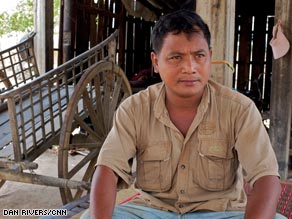
CNN Documentary on Justice in Cambodia
In "Killing Fields: Long Road to Justice," CNN reporter Dan Rivers examines Cambodia's attempt to confront its past with a U.N.-backed tribunal.
An article and videos are on the CNN website.
The Cambodia Tribunal (Official Name: Extraordinary Chambers in the Courts of Cambodia for the Prosecution of Crimes Committed During the Period of Democratic Kampuchea) is a hybrid tribunal, composed of local and international judges. It was created to try senior members of the Khmer Rouge for crimes against humanity.
(Image of survivor, Norng Chan Pha, from the CNN story.)
Monday, May 4, 2009
Special Tribunal for Sierra Leone Rejects Taylor's Acquittal Motion
Judges on Monday rejected a request by former Liberian President Charles Taylor for an immediate acquittal on war crimes charges, saying he must answer allegations that he was part of a campaign to terrorize Sierra Leone's population through murder, rape and mutilation.
Sunday, May 3, 2009
Liberian President, Ellen Johnson Sirleaf
Time Magazine's 10 Questions for Ellen Johnson Sirleaf, the first female head of state in Africa.
Check out her appearance on the Daily Show as well. Her memoir about her extraordinary life is called, This Child Will Be Great.
Image from Vital Voices Global Partnership.With the criticisms recently launched against foreign aid programs, do you think Africa is better off without them? Cherae Robinson, ATLANTA [The same issue of Time features Dambisa Moyo, author of Dead Aid, as one of the 100 Most Influential People.]
No, Africa can still use structured, focused aid. The problem is that aid should be properly used. It must support the government's own development agenda. And the country itself should use its own resources well. I think in a few places in Africa, this is happening.
What impact is the trial of Charles Taylor having on Liberia's prospects for peace and stability? Jeremy Waiser FREETOWN, SIERRA LEONE [Charles Taylor, former President of Liberia, is on trial by the Special Court for Sierra Leone.]
I think Liberians want to put the Taylor era behind them. They want to lead normal lives. They want peace. They're tired of the turmoil that he represented. He's a diminishing figure in Liberia's life.
Friday, May 1, 2009
Indicted War Criminal "Working with UN?"
"It's time now this is addressed head on. Rather than denying or ignoring the role being played by Bosco Ntaganda, the UN should be actively seeking his arrest and transferring him to The Hague."
Release of 4 Generals Ordered by STL Judge
The men were released on the request of the Prosecutor, who determined that there was not sufficient evidence to indict the men.
This Reuters article includes reactions to the decision:
"Ordinary people will ask themselves about the state of the evidence that the commission gathered," said Marieke Wierda, a Beirut-based expert on the tribunal at the International Center for Transitional Justice (ICTJ), a human rights group.
But she said the Hague-based tribunal, which began work only in March, had preserved its credibility by using evidence as the basis for Wednesday's decision to release the four Lebanese former security chiefs for lack of evidence to indict them.
Detlev Mehlis, a German prosecutor who first headed the U.N. inquiry into Hariri's 2005 killing and originally recommended the generals' detention, was scathing about their release.
"This could send the tribunal into oblivion," he told Germany's Frankfurter Allgemeine newspaper.
An STL statement is available on its website.