Deogratias fled across a river already beginning to choke with Tutsi corpses into the forests. After days hiding out in the woods—to echoed screams—he realized he had to get out of Burundi. He thought he had an option for safety—to make his way across the border to Rwanda. He nearly didn't make it. He was stumbling from one catastrophe to another—straight into the heart of the Rwandan genocide. The president there was murdered, too, and the extermination of nearly 1 million people—mostly by machete, wielded at high speed–erupted. It took 100 days. "Before the end of the night, the cockroaches are not going to wake up again," the mobs would sing on their killing frenzies.
And suddenly Deogratias was standing in an American airport, with $200 in his pocket and trauma cluttering his head, claiming he had work to do in New York City. A friend had pointed him toward Burundi's airport and urged him to get as far away as he could. He slept in boarded-up buildings and in Central Park and marvelled: "Almost everyone looked happy. Or at least no one looked alarmed. And no one looked terrified. These were people just going about their business, greeting their friends and their families, as if they didn't know there were places where dogs were trotting about with human heads in their mouths. But how could they not know?"
-----------------------------
Deogratias seems to have come to terms with his memories of the genocide by convincing himself that the populations of both countries were innocent, and even the perpetrators—who remain faceless and nameless and off-stage for virtually the entire narrative—were simply "misled." They didn't know what they were doing; they were deceived. But this was a grassroots genocide, stoked by governments but carried out—with horrific efficiency—by ordinary people. Those rows of bodies I looked at were carved up by their neighbors, who were staring them in the face. It's hard for the reader to escape the conclusion that Deogratias can live with what happened and build his hospital and do good only by lying to himself about the nature of the recent past.This raises the chewy problem of why Kidder is telling this story. Is it primarily an inspirational tale of an immigrant-made-good, a repudiation of Lou Dobbs-style bigotry? If so, his book succeeds 10 times over in an uncomplicated way. Or does Kidder believe primarily in the need to record accurately what happened during the darkest moments in human history?
Monday, August 24, 2009
Memory in the Aftermath of an Atrocity


Friday, June 12, 2009
"Enfants Mauvais Souvenirs"
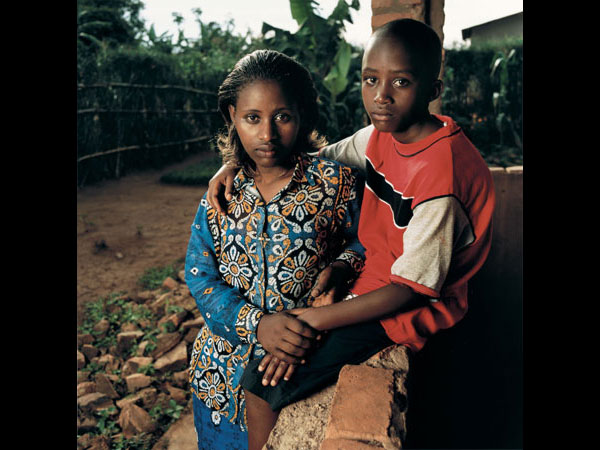
Slate has an article and slideshow on images by photojournalist Jonathan Torgovnik's of children born of rape during the Rwandan genocide. An estimated 20,000 children were born to Tutsi women who were systematically raped and forced into sexual servitude by members of Hutu militia groups. Torgovnik's images and the testimonies he collected are published in his book "Intended Consequences: Rwandan Children Born of Rape."
(Image: "Odette with her son, Martin," Intended Consequences: Rwandan Children Born of Rape, photographs and interviews by Jonathan Torgovnik (Aperture, 2008). From the Slate alideshow.)The testimonies do not make for easy reading. More than half of the women Torgovnik interviewed are HIV-positive. Most live in dire poverty, ostracized by their own families and communities because of the stigmas attached to rape and AIDS. In Rwanda, a heavily patriarchal society, children of wartime rape are perceived as belonging to the enemy. As Josette, the mother of Thomas, recalls, "My uncle didn't welcome me into his house. He asked me who was responsible for my pregnancy. I said if I am pregnant, then it must be the militias since many of them had raped me. He said I shouldn't enter his house carrying a baby of the Hutus and chased me away. I left, but I didn't know where to go. Later, my uncle told me that I could only enter his house if I agreed to throw away the child."
The women discuss their own feelings about their children with heartbreaking candor. Some confess their inability to feel love or affection for children who are living reminders of the terrible ordeals they endured. Others say that their children are their only source of hope and consolation, that without them they wouldn't have the will to survive. Their stories are stark dramas of evil and innocence, brought to life with horrific specificity.
Event in NYC: Human Rights Watch International Film Festival
The New York Times has more information on the films.
Monday, June 1, 2009
Rwandan Charged in Finland
On Monday, Finland's prosecutor-general said a pre-trial investigation had found evidence that Mr Bazaramba, a Hutu, had "committed a crime of genocide in the municipality of Nyakizu in April and May 1994 with intent to destroy the Rwandan Tutsis partly or totally".
Mr Bazaramba was also charged with 15 counts of murder, he said.
Rwandan authorities accuse him of having participated in planning, leading and carrying out the massacre of 5,000 Tutsis while the head of the Union of Baptist Churches of Rwanda (UEBR) in Nyakizu.
Finnish prosecutors determined that there was enough evidence to try him in Finland. In February, the Rwandan government expressed disappointment in Finland's decision not to extradite Bazaramba. The UN International Criminal Tribunal for Rwanda had said that suspects who are referred to Rwanda may not receive a fair trial.
According to the BBC article, "Finnish law allows prosecutions for crimes against humanity wherever they are committed." A previous post on universal jurisdiction is here.
Monday, May 11, 2009
Rwandan President Paul Kagame on Aid
The Foreign Policy blog has some observations.
Then again, it's both fantastic and unsurprising to hear Kagame promising to wean his country from development aid -- through savy business ventures and smart economic policy. In fact, that's what the president has already started to do, and it's the reason that many consider Rwanda the emerging Singapore of Sub-Saharan Africa. The example is one to follow -- and not just in the developing world.
A previous post on Dambisa Moyo's Dead Aid, which is mentioned in Kagame's article, is here.

 Posts
Posts